
A buyer walked away from a Sun City doublewide last spring because the seller couldn’t produce two titles. One title per section is the rule here, and a doublewide carries two of them. A single paperwork gap cost a seller six weeks. Selling a mobile home without land in Arizona runs on a completely different track than selling a house, so the people who struggle most are the ones who assume otherwise.
What Does Selling a Mobile Home Without Land in Arizona Really Mean?
A widow in Mesa called me after her park raised lot rent again and her kids wanted her closer to Tucson. She owned the home outright but had never owned the dirt underneath it, not once in twenty-two years.
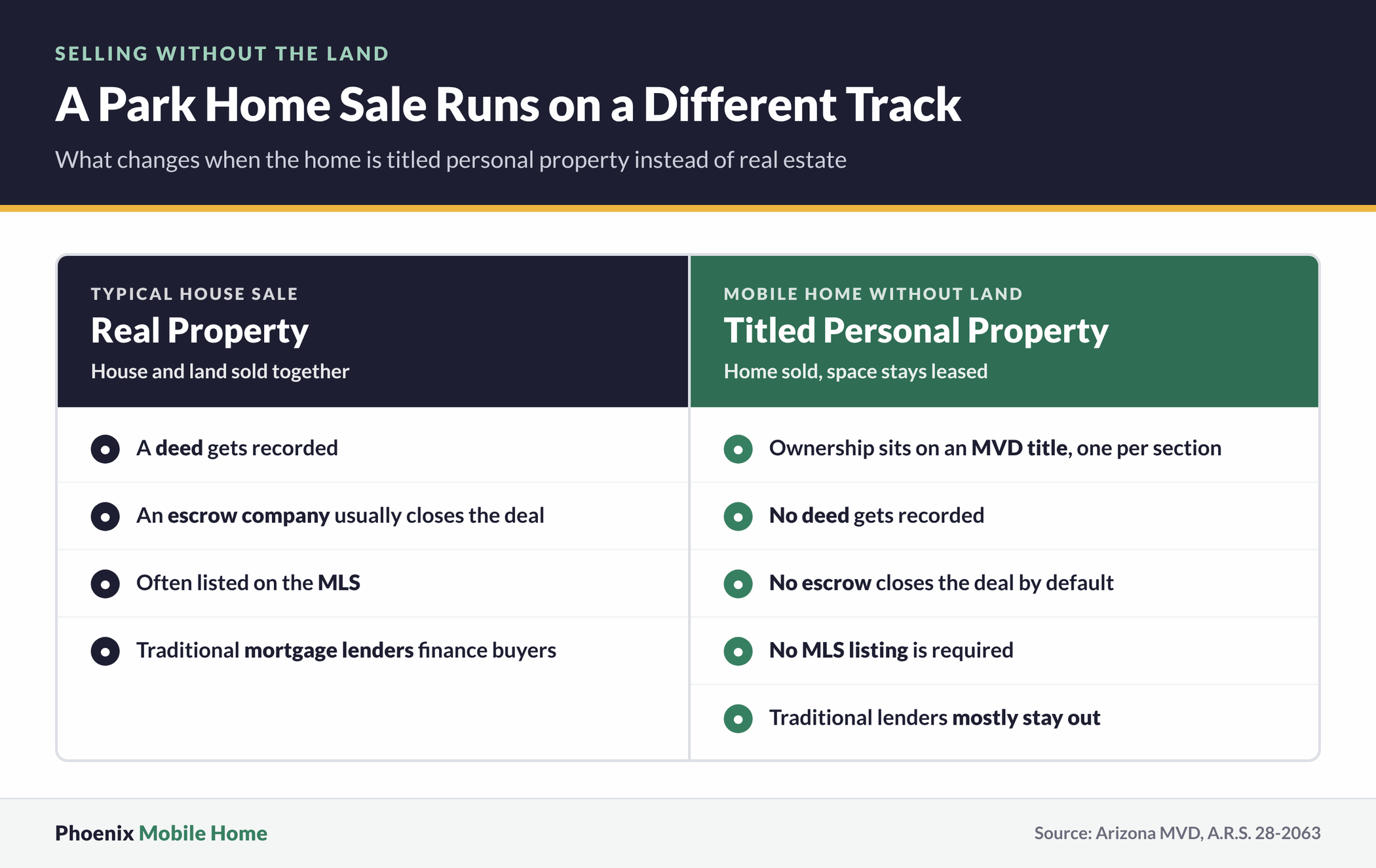
That’s the situation for most sellers here. Your home sits on leased space in a community, and when you sell a mobile home without land in Arizona, you’re transferring a titled asset, not a parcel of real estate. A manufactured home in Arizona generally begins life as personal property with a title issued through the Motor Vehicle Division, similar to how a vehicle is titled. A home on rented space in a community normally stays that way.
What changes because of that classification? Just about everything downstream. No escrow company closes your deal by default. No deed gets recorded. No MLS listing is required, and traditional mortgage lenders mostly stay out of it.
A while back three siblings in Apache Junction inherited their mother’s 1986 singlewide and burned through two agent listings that expired with zero offers. Both agents were competent people who simply didn’t work in chattel sales and kept pricing the home like a condo. We closed it in under three weeks after the second listing died.
Arizona law treats affixed homes differently. An Affidavit of Affixture converts a manufactured home from personal property to real property. So if that home is later removed or sold separately from the parcel, it has to be re-titled through motor vehicle. So if your parents filed affixture years ago and you’re now selling a mobile home without land in Arizona, there’s an unwinding step before you can sell anything at all. Most sellers in parks never had affixture filed, which actually simplifies things.
Who Legally Owns a Mobile Home Without Land in Arizona?
“My name’s on the lot rent bill, doesn’t that make me the owner?”
No. Lot rent only proves you’ve been paying to park there. Ownership of a mobile home without land in Arizona lives on the certificate of title, and whoever is printed there controls the sale. Under A.R.S. 28-2063, a manufactured home without a recorded Affidavit of Affixture is issued a title through MVD, a multi-section unit has a title for each section, and ownership changes must be transferred through MVD.
Heirs run into this constantly. A parent dies, the family keeps paying space rent for a year, and nobody realizes the title still carries the deceased parent’s name. Paying rent doesn’t transfer ownership of a mobile home without land in Arizona, and it never has.
Lost titles are the other recurring headache I see.
If the original title vanished sometime during the Clinton administration, a path forward still exists. A bonded title or another MVD remedy may be required before a clean transfer can happen, and the MVD’s mobile home pages at azdot.gov lay out the current forms. I’d call before driving anywhere; staff at authorized third-party offices across Arizona handle these daily and can tell you in five minutes whether your file is clean.
A lien on the title can complicate ownership too. Older chattel loans from defunct Arizona lenders sometimes sit unreleased on title decades after the balance was paid. The lien has to clear before a sale closes, and that’s not optional since discovering it on closing day is miserable for everyone in the room.
What’s Your Mobile Home Worth Without the Land in Arizona?
A 1998 doublewide in a Chandler park appraised nowhere near what its owner expected after she compared it to site-built listings down the road. Once she saw park comps instead of neighborhood comps, her expectations landed within a week.
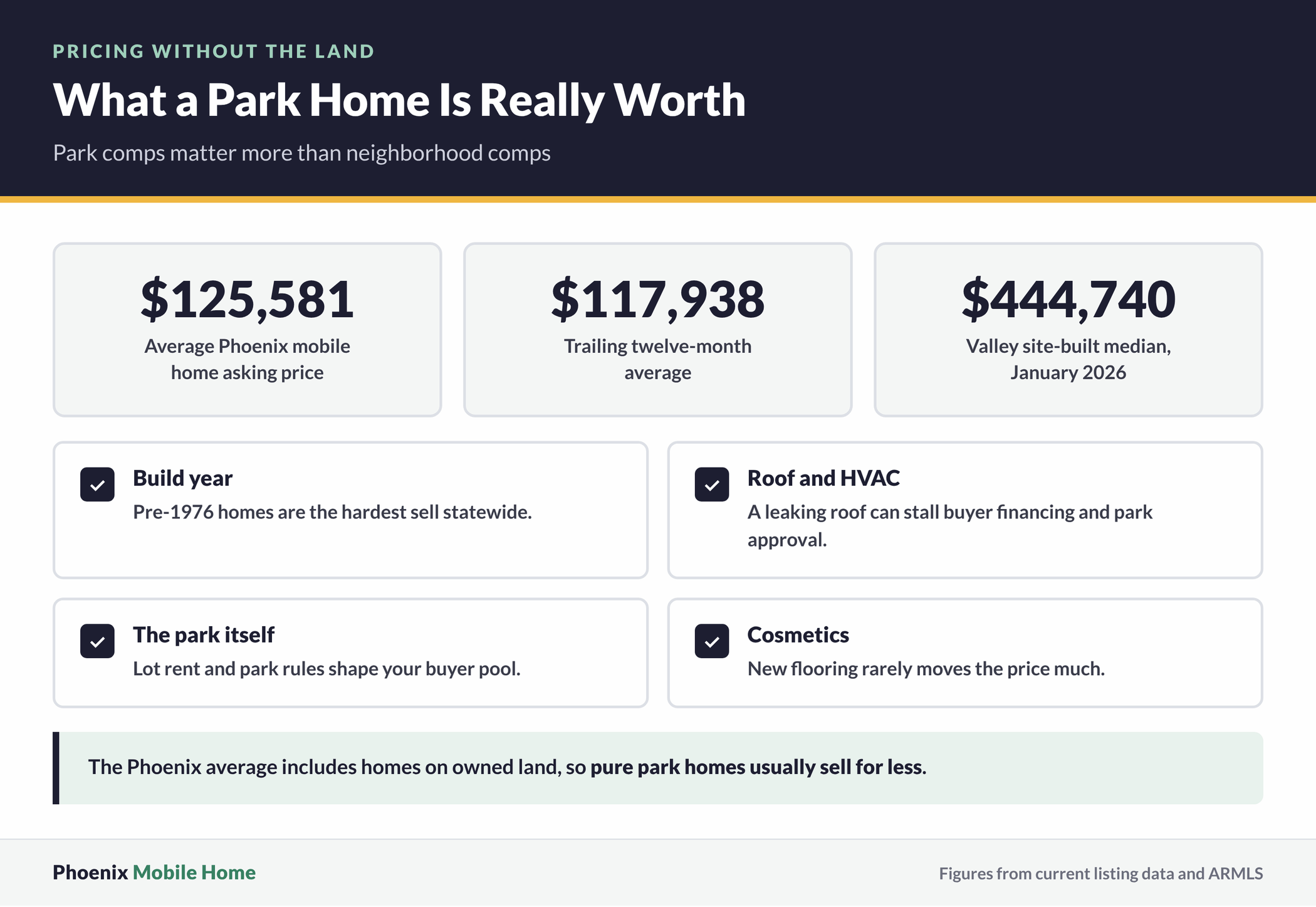
Mobile homes in Phoenix, as of the current listing data, average around $125,581 in asking price, up roughly 6% against the trailing twelve-month average of $117,938. The figure includes homes on owned land, which inflates it. Pure park-based homes sell for less.
Compare that against the site-built market and the gap explains why buyers still want these homes. ARMLS data from January 2026 showed 24,358 active listings across the Valley with a median site-built price of $444,740 and an average of 94 days on market. Affordability is the whole story.
Tucson runs its own pattern. Mobile home prices there have held steady, up about 2% against a twelve-month average of $170,114.
Three things drive value when you’re selling a mobile home without land in Arizona: build year, roof and HVAC condition, and the park itself. Pre-1976 homes are the hardest sell statewide, since financing and park acceptance both tighten. Swamp coolers versus real AC matters more in Yuma than in Flagstaff.
My opinion, and plenty of agents disagree: cosmetic upgrades rarely pay off on a mobile home without land in Arizona. New flooring in a 1983 singlewide won’t move the price much, but fixing a leaking roof will, because a leaking roof kills buyer financing and park approval simultaneously.
How Does Park Location Affect Selling a Mobile Home Without Land?
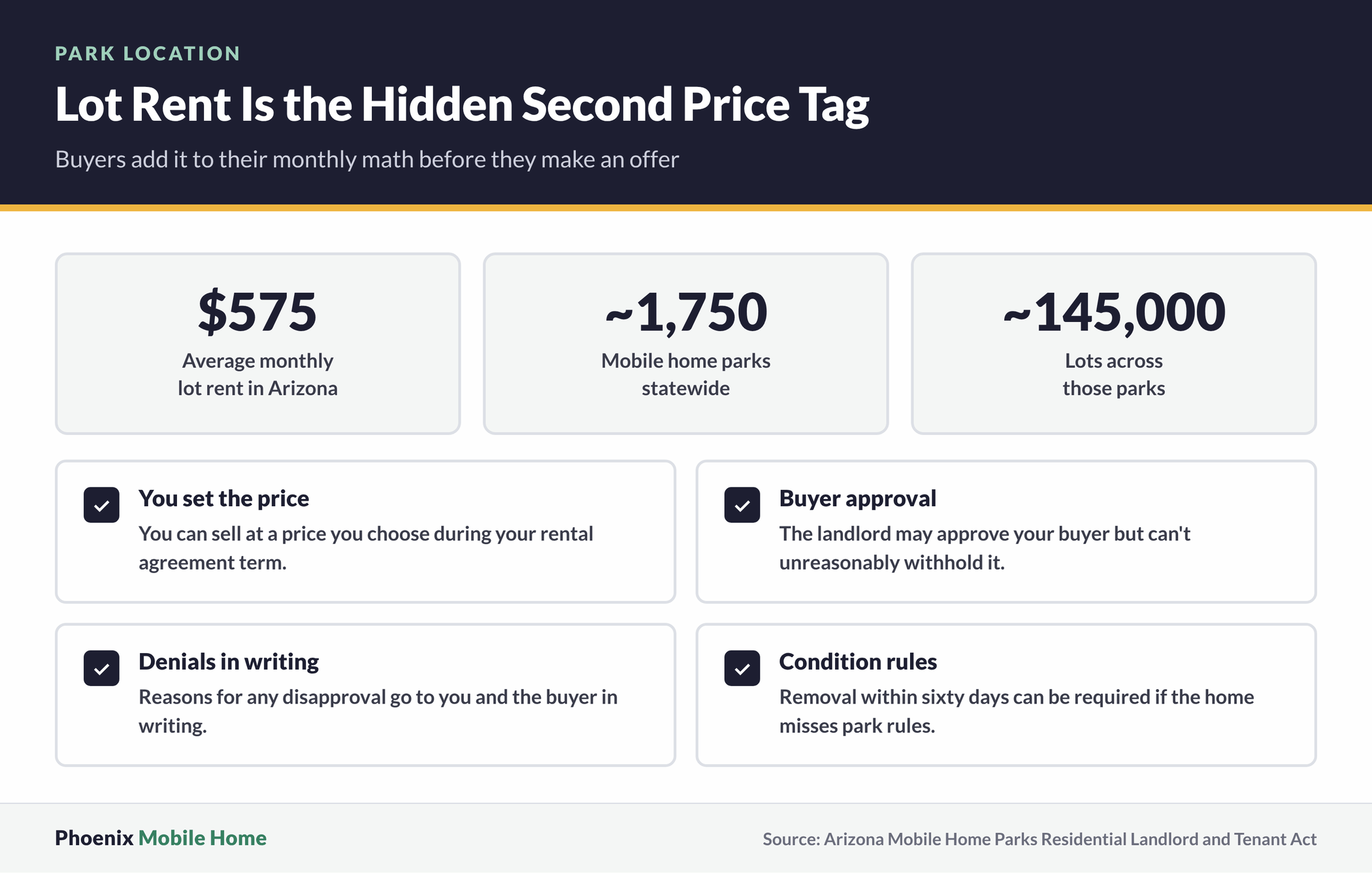
$575 a month. The average lot rent across roughly 1,750 Arizona mobile home parks holding about 145,000 lots stands at that figure, and that number shapes your buyer pool more than your kitchen does.
Lot rent is the hidden second price tag. A buyer looking at your home in Sun Lakes isn’t just evaluating your asking price; they’re adding lot rent to their monthly math. Parks charging well above the Arizona average shrink the buyer pool for every home inside them, no matter how nice those homes are.
Age restrictions cut both ways. A 55-plus community near Apache Wells narrows who can buy but often attracts cash-ready retirees relocating from colder states.
Park approval is a real gate, and Arizona law is what governs it. As a park resident and homeowner, you have the right to sell your mobile home at a price you choose during your rental agreement term. The landlord may reserve the right to approve your purchaser as a tenant. Approval cannot be unreasonably withheld, and the landlord must notify both you and the prospective purchaser in writing of any reasons for disapproval. The Arizona Department of Housing publishes the full Mobile Home Parks Residential Landlord and Tenant Act, and I’d read the sections on sales before listing.
One protection worth knowing: for a home manufactured after June 15, 1976, sold to a tenant who otherwise qualifies, a landlord can’t require removal from the park solely because of the home’s age. Even so, removal within sixty days after a tenant’s sale can be required if the home doesn’t meet current park rules on size, condition, and appearance. Ask your manager where your home stands on those rules before a buyer ever walks through, because surprises there blow up deals late.
Can You Sell a Mobile Home Without Land by Owner in Arizona?
Your park manager cannot charge you a sales commission. A landlord can’t exact a commission or fee on your sale unless they’ve acted as your agent under a written agreement. Plenty of Arizona sellers pay one anyway because nobody told them otherwise.
Selling by owner works here more often than it does with site-built houses. There’s no MLS requirement for a mobile home without land in Arizona, and most real estate agents won’t touch chattel transactions because the commission on a $40,000 singlewide doesn’t justify the paperwork.
What you take on instead: marketing, buyer screening, park coordination, and the title office trip.
Buyer financing is the quiet deal killer. Conventional mortgages generally don’t apply to a mobile home without land in Arizona because there’s no real property securing the loan. Chattel lenders exist, but their rates run higher and their age cutoffs are strict. Cash buyers dominate this market for exactly that reason.
Do you have the patience for tire-kickers? Park homes attract a high volume of inquiries and a low conversion rate. I’ve watched sellers field forty calls and get two serious showings.
Pricing is where by-owner sellers stumble. Anchoring to what you paid in 2006 or to what your neighbor is asking produces a listing that sits for months. Look at what’s closed inside your park and the two parks nearest you, not what’s listed. Listings tell you hopes; closings tell you the market.
Teams like Phoenix Mobile Home buy directly and skip the listing process entirely, which is a reasonable option if the timeline matters more than squeezing the last few thousand dollars out of a sale.
Who Buys a Mobile Home Without Land in Arizona?
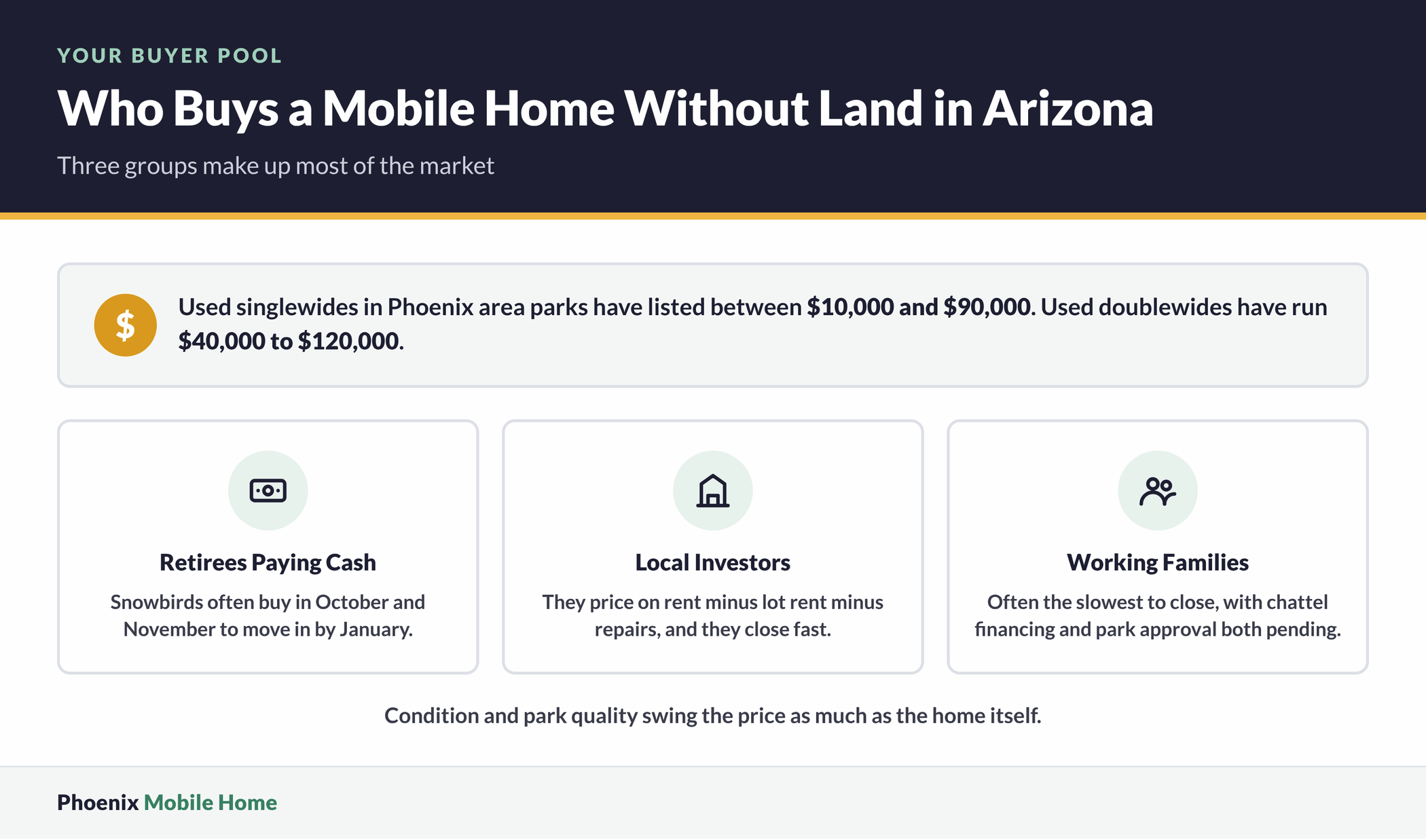
And that cash reality shapes exactly who shows up at your door. Three groups dominate purchases of a mobile home without land in Arizona, and I’ve sold to all three types. These are retirees paying cash, local investors who rent homes back inside parks, and working families priced out of site-built housing.
Snowbirds matter enormously in markets like Yuma, Casa Grande, and the Prescott Valley corridor. Winter visitors buy in October and November so they can occupy by January, which means listing a mobile home without land in Arizona in late June puts you in a much smaller pond.
Investors look at different math. They’re calculating rent minus lot rent minus repairs, and a home needing $12,000 in work gets priced accordingly. They also close fast and don’t need park financing approval, since they’re writing checks.
Used singlewides in Phoenix-area parks have been listing between $10,000 and $90,000, with used doublewides running $40,000 to $120,000. Condition and park quality swing outcomes by that much, the spread tells you.
Families buying their first home are often the most emotionally invested and the slowest to close, because they’re applying for chattel financing and park tenancy at the same time. Both approvals can stall.
Cash buyers who specialize in this niche understand the title mechanics, the tax clearance step, and the park approval dance without being taught. That’s genuinely worth something when you’re trying to sell a mobile home without land in Arizona on a deadline.
What Steps Are Involved in Selling a Mobile Home Without Land?
For years I underestimated the tax clearance step and assumed sellers could handle it on closing day. Wrong.
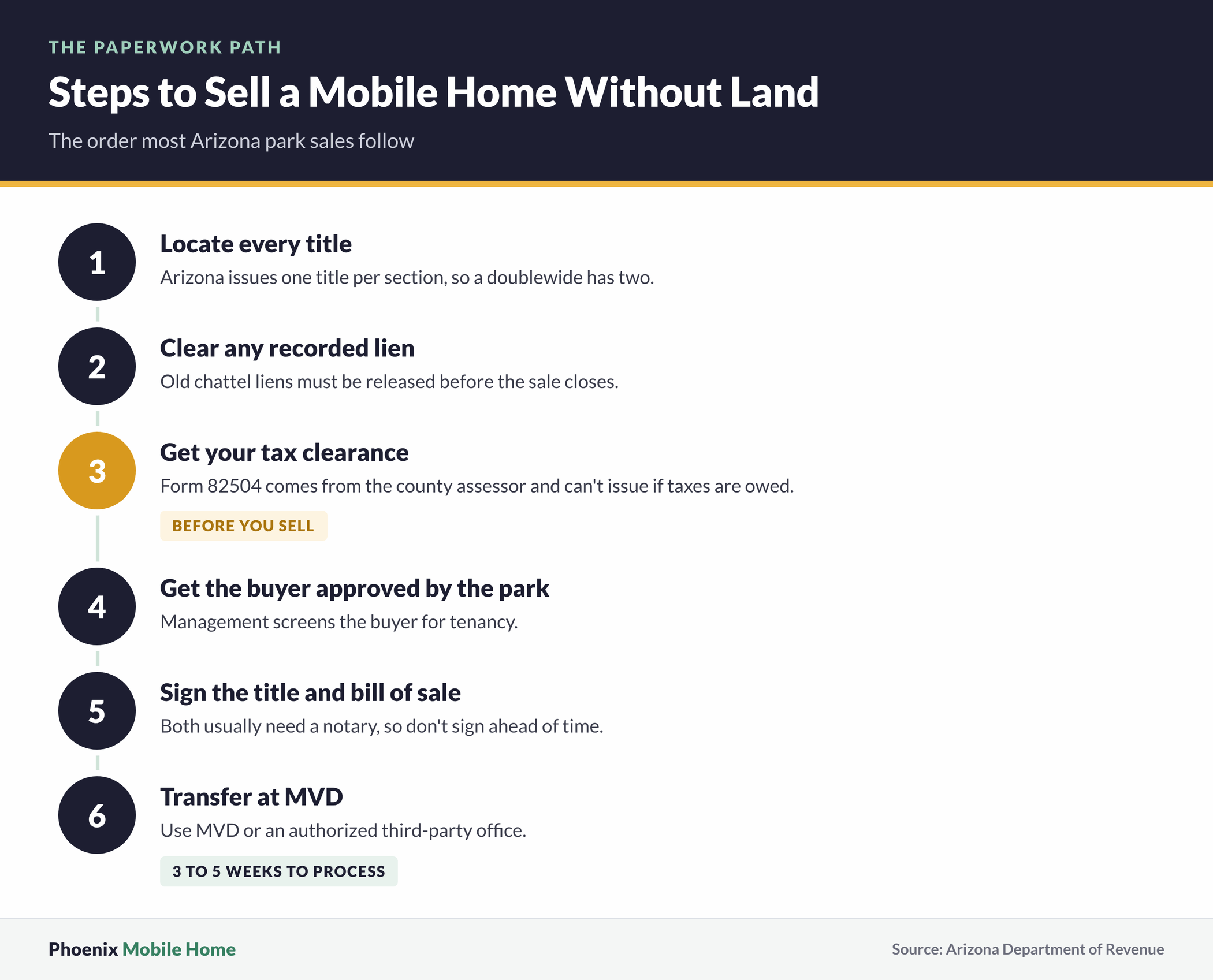
Arizona requires a property tax clearance before these transactions complete. Form 82504 must be obtained prior to selling or moving certain manufactured housing units wider than eight feet, and it’s issued by the assessor of the county where the home sits. A clearance can’t be issued if any taxes are owed on the unit. The Arizona Department of Revenue’s Manufactured Housing Manual walks through the process in detail.
Your sequence looks roughly like this. Locate every title, one per section, then clear any recorded lien. Pull your tax clearance from the county assessor, confirming current taxes through the treasurer’s office. Get your buyer approved by the park. Sign the title and a notarized bill of sale, then transfer at MVD or an authorized third-party office.
Notarization trips people up. Both the titles and the bill of sale typically need a notary present, so don’t sign anything at your kitchen table ahead of time.
Timing varies. Title transfers in Arizona commonly take three to five weeks to process, though your possession date and your money don’t have to wait on MVD’s internal processing.
A man called on a weekday afternoon from Casa Grande, splitting assets in a divorce, with his ex-wife’s belongings still stacked in the carport. He didn’t want to negotiate or stage anything; he wanted the mobile home without land sold and the chapter closed. We handled the clearance and the park paperwork, and he signed once.
That’s the service a direct buyer like Phoenix Mobile Home provides: the administrative weight comes off your shoulders.
Frequently Asked Questions About Selling a Mobile Home Without Land in Arizona
Can You Buy a Mobile Home Without Owning the Land Under It?
Yes, and that’s how the majority of park homes change hands across Arizona. You purchase the structure itself and separately sign a rental agreement with the park for the space, which means two relationships instead of one: ownership of the home, tenancy on the lot. Buyers should always read the park’s rules and lot rent history before signing, since that monthly obligation continues for as long as the home stays put.
Do I Need a Real Estate Agent to Sell a Mobile Home Without Land in Arizona?
You don’t. A mobile home without land in Arizona is personal property, so there’s no listing requirement and no deed to record. Many agents decline these sales anyway because the transaction runs through motor vehicle rather than escrow. If you’d rather not manage the paperwork yourself, a direct buyer or a dealer who specializes in park homes can take it over.
What Happens If I Owe Back Taxes on My Mobile Home?
The sale stalls until they’re paid, because the county won’t issue the clearance described earlier with a balance outstanding. Call your county treasurer with the home’s VIN or serial number and ask for the current payoff. Some buyers will handle the arrears at closing and deduct that amount from your proceeds, which is a common arrangement in Arizona park sales.
Can the Park Stop Me From Selling My Mobile Home Without Land?
Not from selling, no. Arizona law protects your right to sell at a price you choose, though the landlord can screen your buyer for tenancy and must explain any denial in writing. Where parks do have leverage is condition: if your home falls short of current park rules, removal can be required after the sale. Ask management for their standards in writing early.
How Fast Can I Sell a Mobile Home Without Land in Arizona?
Cash sales can wrap in one to three weeks once titles and tax clearance are in hand. Listed sales that depend on buyer chattel financing plus park approval typically run longer, often a couple of months. Winter months move faster in snowbird markets across southern Arizona, while summer listings in the Valley tend to sit.
Does a Doublewide Require Two Separate Titles in Arizona?
It usually does, since Arizona issues one title per section. Sellers who only locate one title often discover the second went missing years ago, and that discovery is better made in week one than on signing day. If a title is gone, ask MVD or an authorized third-party office about the bonded title process before you accept an offer.
If you’re weighing your options on a mobile home without land in Arizona and want someone to walk through the title, tax clearance, and park questions with you, we’re glad to talk it through. No pressure, no obligation, and no expectation that you sell to anybody at all.
What the Phoenix Market Means for Park Home Sellers
Phoenix is our home market, and buyers there have more choices than they did a year ago. Active listings across Metro Phoenix rose 6.8% to 27,427 in October 2026, according to AZ Big Media. More site-built inventory gives buyers room to wait.
A fairly priced park home with clean titles and a tax clearance in hand still stands out, whether it sits in Phoenix, a Mesa park or somewhere in between.
Talk Through Your Mobile Home Sale With Us
Got a missing title, a tax clearance question or a park manager who won’t call back? Reach out to Phoenix Mobile Home and we’ll walk through it with you. You can also fill out the short form below to get a cash offer on your mobile home. There’s no obligation and no pressure.