
A swamp cooler running fourteen hours a day in July pushes moisture into a metal-roofed single-wide at a rate no desert climate can offset. The quiet engine behind most mold issues I find in Arizona mobile homes. Then they pull back the vinyl skirting in a Mesa park and find a black bloom climbing the belly board.
Selling a mobile home with mold issues in Arizona isn’t a dead end. It’s a different sale with different buyers, different paperwork, and a different price conversation. Let’s get into how it works.
What Causes Mold Issues in an Arizona Mobile Home?
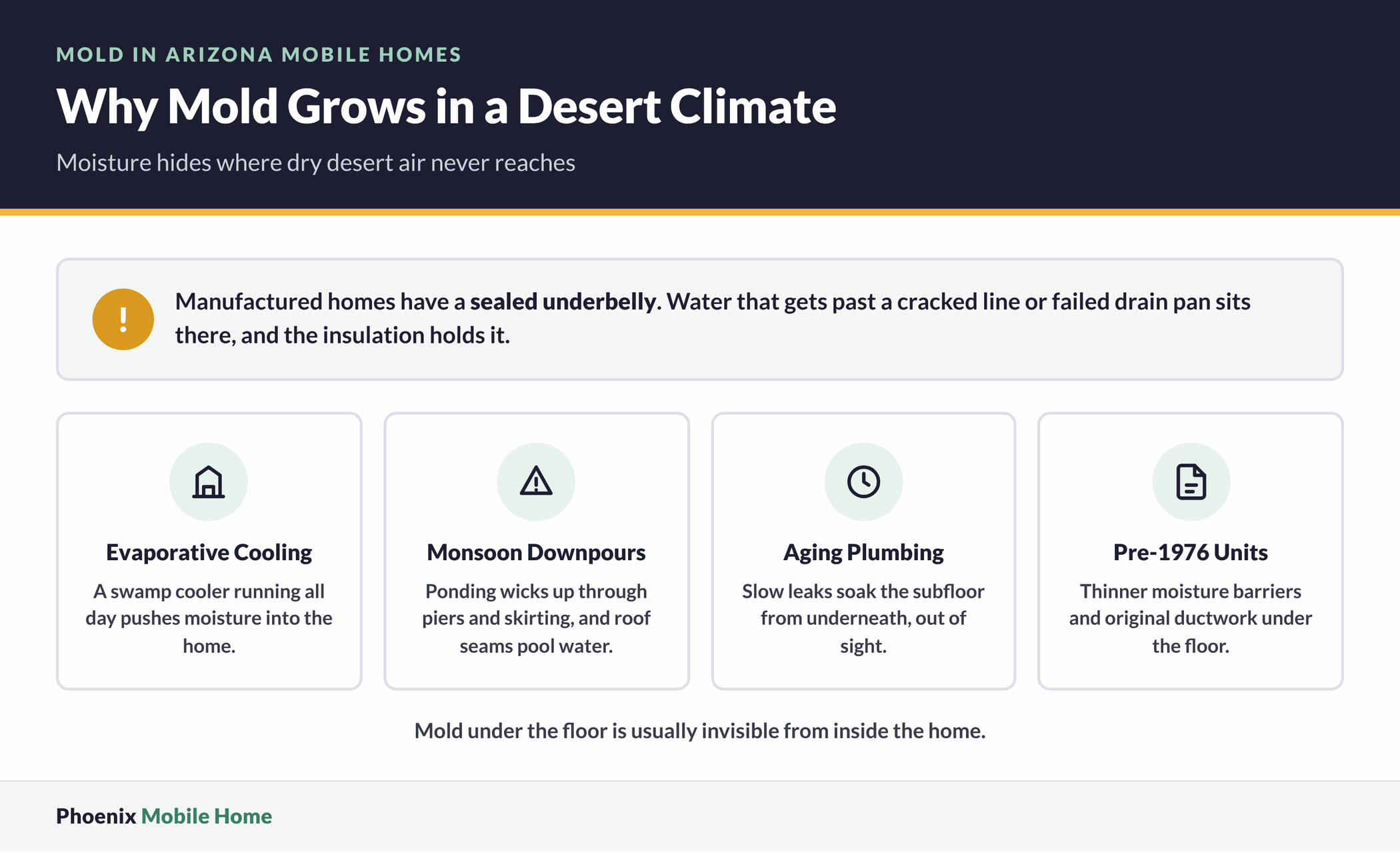
You’re probably thinking mold can’t survive in a place that hits 115 degrees. Plenty of Arizona homeowners tell me the same thing right before we open an access panel, and that’s usually when the smell gives it away. Evaporative cooling, monsoon downpours, and aging plumbing create pockets of damp that never see sunlight.
Manufactured homes in Arizona have a structural quirk that site-built houses don’t: a sealed underbelly. Water from a cracked supply line or a failed drain pan sits in that cavity, and the insulation holds it. Within a few weeks, you’ve got mold issues spreading across the subfloor from underneath, invisible from inside the home.
Monsoon season does the rest. Ponding around the perimeter in Tucson or Apache Junction wicks up through piers and skirting. Flat or low-slope roofs on older Arizona units pool water at the seams, so the roof coating fails quietly. Nobody climbs up to check until a ceiling stain appears.
Early last year, I bought a double-wide in Casa Grande from two adult children whose mother had moved into assisted living. They’d rented it out for three years and hated being landlords. They only found the mold when a tenant left the bathroom window swamp cooler running through August.
Age matters too. Arizona has a lot of pre-1976 units still occupied, and those predate federal HUD construction standards entirely. Thinner moisture barriers, single-pane windows, and original ductwork under the floor all invite the same outcome. Mold in a 1972 single-wide usually traces back to materials never built to last fifty years.
Is the Mobile Home in an Arizona Park or on Private Land?
This single question decides which paperwork and rules apply to your sale. I spent my first couple of years treating every mobile home sale in Arizona like a real estate closing, and that cost me time on sales that were never real estate to begin with.
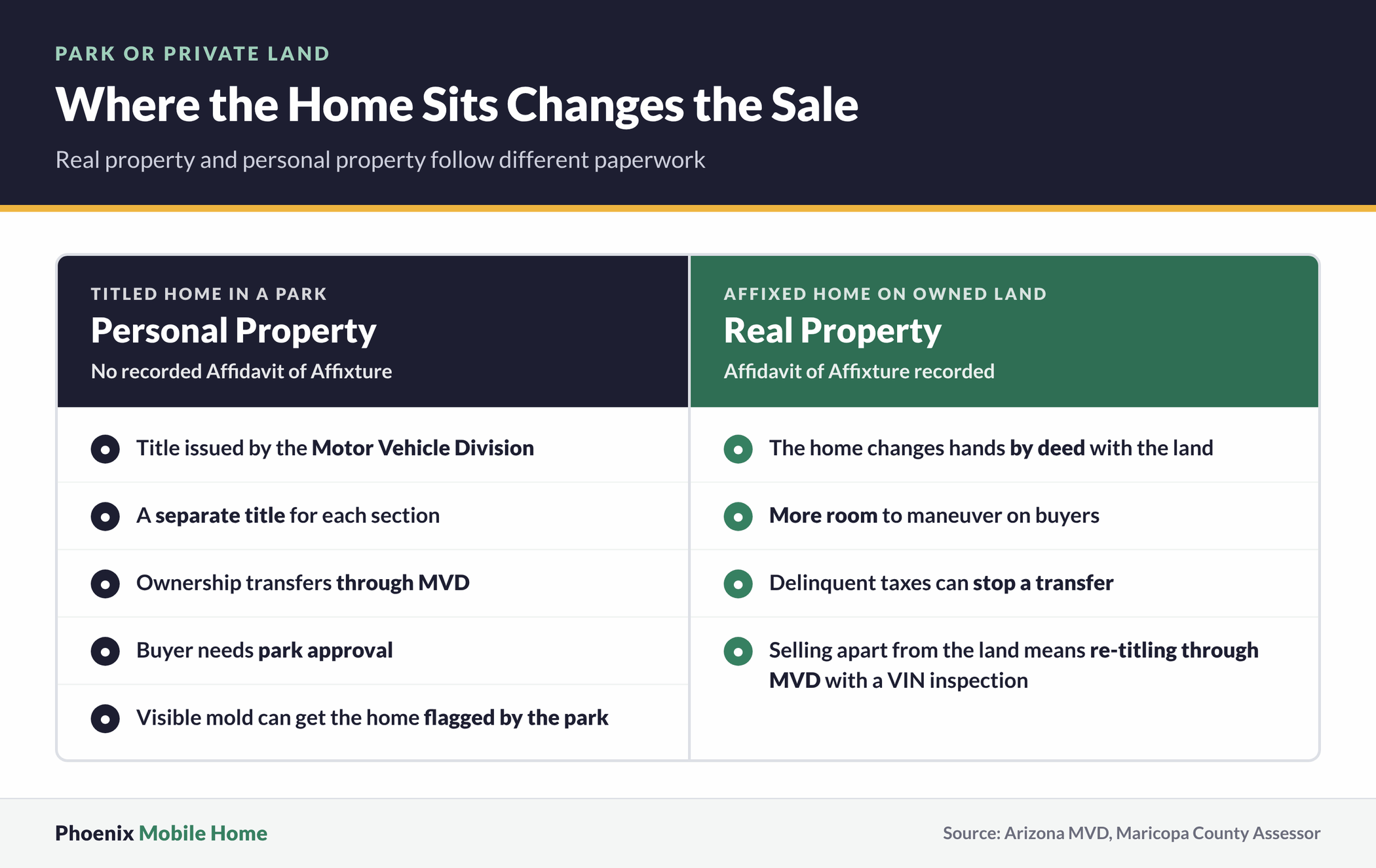
It comes down to whether Arizona treats the home as real property or personal property. A manufactured home without a recorded Affidavit of Affixture carries a title issued by the Motor Vehicle Division, with a separate title for each section of a multi-section home. When ownership changes, those titles transfer through MVD. It’s an MVD transaction, not an escrow closing. If an affidavit was recorded, the MVD title was surrendered and the home changes hands with the land by deed.
Why does this matter for a home with mold? The two paths attract completely different buyers.
A titled home in a Phoenix-area park sits on leased land, so park management has to approve your buyer before anything closes. Parks run background and income checks. Several Arizona communities also enforce age or condition standards, and a unit with visible mold can get flagged before a buyer ever applies. Some parks will demand repairs or removal of a home they consider uninhabitable.
On owned land, you’ve got more room to maneuver. The Maricopa County Assessor’s office explains the affixture and re-titling steps. Delinquent taxes on a manufactured home get posted to that unit’s motor vehicle records, and that’ll stop a transfer cold.
There’s one more wrinkle for Arizona sellers. A home that was affixed but now needs to sell separately from the land has to be re-titled through MVD, including a VIN inspection. Mold doesn’t change that process. It does mean you’ll want the paperwork sorted before a buyer with cash is standing in your living room.
What to Disclose About Mold Issues to Arizona Buyers
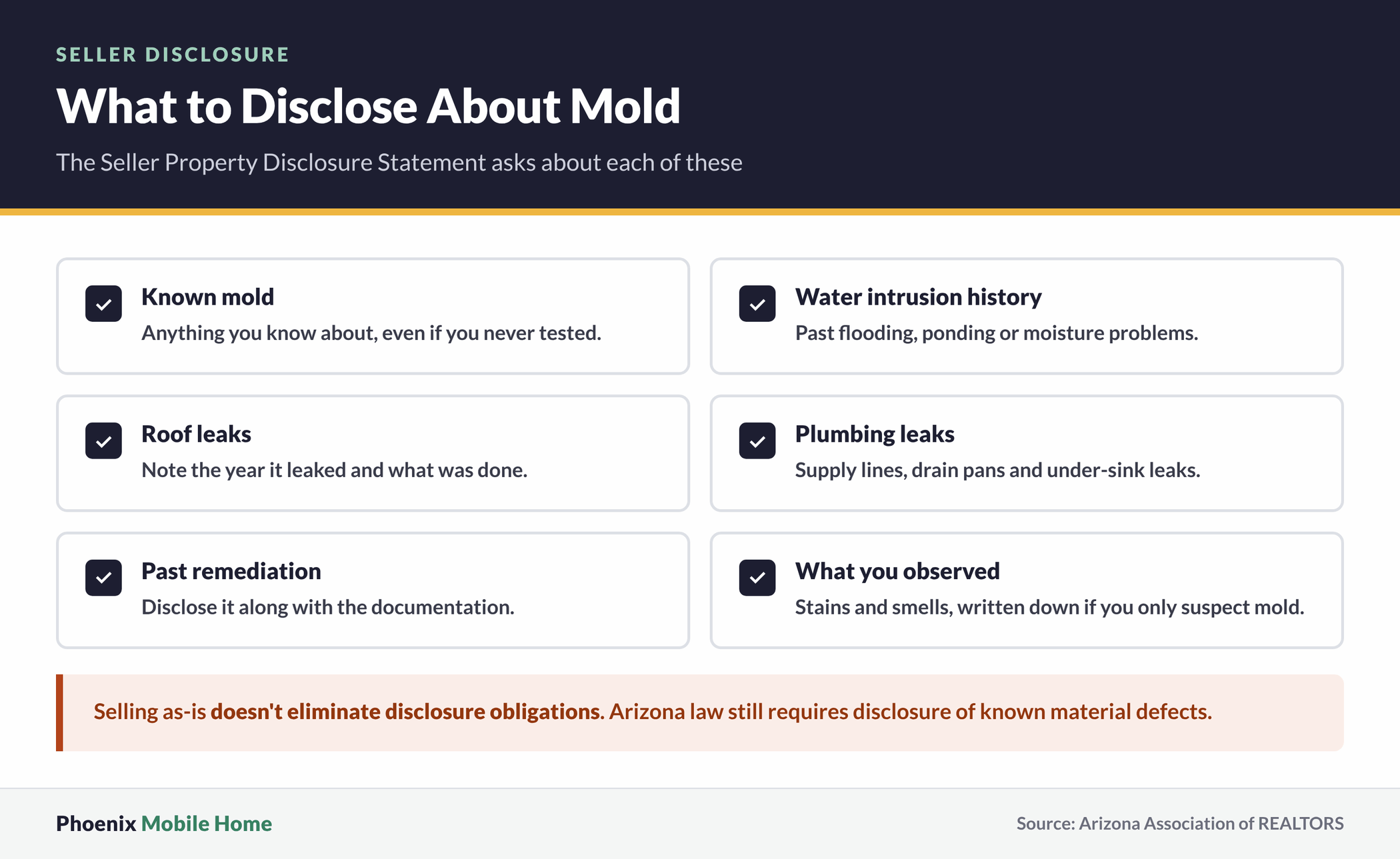
Sellers who fudge this form almost always regret it. Twenty-three words on a disclosure form have cost Arizona sellers more money than any remediation bill I’ve seen quoted. The Seller Property Disclosure Statement from the Arizona Association of REALTORS asks directly about known mold, water intrusion history, roof leaks, and plumbing leaks. Answer it honestly. You can read the exact wording on the Arizona REALTORS site before you commit to anything.
Arizona’s disclosure duty surprises people because it isn’t a mold statute at all. Arizona is a disclosure state, and the seller’s duty comes from common law set by the courts, not from a dedicated mold law. You must disclose known facts that materially affect the property’s value and that a buyer couldn’t reasonably discover alone.
Selling as-is doesn’t erase that, because Arizona law still requires disclosure of known material defects. Say it anyway, in writing.
What if you only suspect mold and have never tested? Write down what you’ve observed: the stain, the smell, the year the roof leaked. The duty covers what you know, and Arizona doesn’t require you to test for mold you have no reason to suspect. Documenting your uncertainty protects you better than a guess in either direction.
Keep every receipt from past work. If a Chandler contractor replaced subfloor in 2019, that invoice belongs in your file. If you had mold remediated, you must disclose it along with the documentation.
Does Fixing Mold Issues Before Selling Pay Off?
Most of the time in Arizona, no, and I’ll stand behind that.
Remediation on a manufactured home rarely stops at killing the mold. The moisture source has to go first, which usually means roof coating, a plumbing repair, or regrading the lot. Contractors open a wall, find the belly wrap saturated, and the estimate doubles on the second visit.
Compare that to the asset. Arizona’s average manufactured home sale price has run around $139,600, against a $450,067 median for all single-family homes. Used single-wide in Phoenix-area parks run roughly $10,000 to $90,000, with double-wide between $40,000 and $120,000. I’ve seen owners spend fifteen grand chasing mold on a home worth thirty, and the math just stops working.
Repair does pay in a narrower case. Localized mold from one failed fixture, caught early, in a newer unit on land you own: fix that.
What I’d avoid is the half-measure. Bleaching a surface and repainting doesn’t remove anything, and any Arizona inspector worth hiring will find moisture behind the paint with a meter in under a minute. It’s also the version most likely to land you in a dispute after closing, since you now have knowledge you didn’t disclose.
Pre-listing inspections split opinion. No Arizona statute requires testing before listing, but an inspection turns uncertainty into a documented fact you can act on. If you’re selling to a cash buyer who inspects anyway, save the money.
How to Price an Arizona Mobile Home with Mold Issues
How much am I losing because of this?
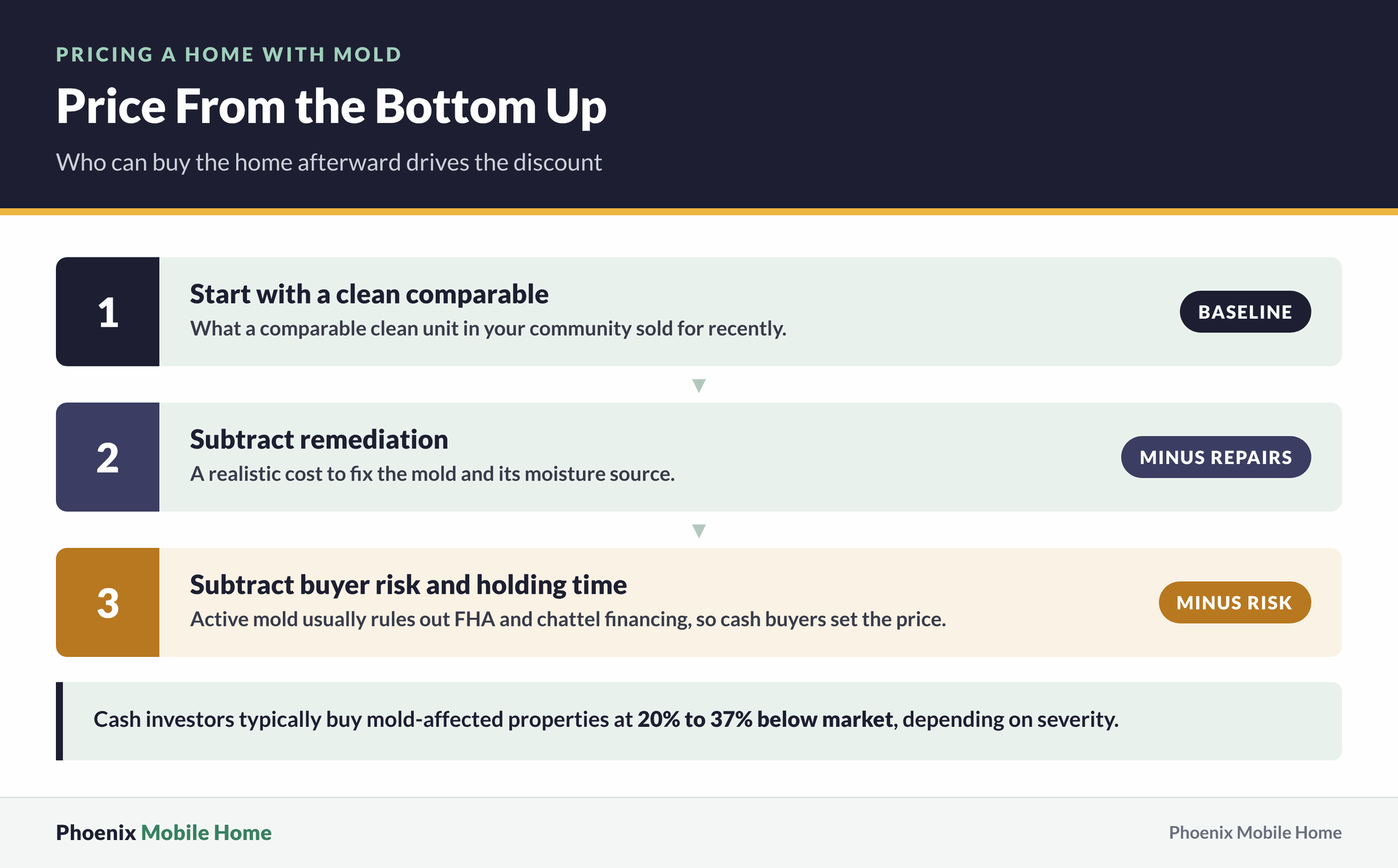
That’s the first question almost every Arizona seller asks me. The honest answer is that the discount depends less on the mold than on who can buy the home afterward. Lenders are the hinge. A unit with active mold generally won’t pass an appraisal for FHA or chattel financing, so your buyer pool shrinks to people with cash. That’s the whole mechanism.
For a reference point, Arizona home prices were down 1.5% year over year in October 2026 at a $433,185 median, with median days on market at 63. Softer conditions mean buyers have choices, and a home with mold competes against clean inventory in the same park.
Price from the bottom up, not the top down. Start with what a comparable clean unit in your community sold for recently. Subtract a realistic remediation cost, then subtract again for the buyer’s risk and holding time. Guessing gives you a listing that sits.
Cash investors and iBuyers typically buy mold-affected properties at 20% to 37% below market, depending on severity. That range is wide for a reason.
Where the park sits in Arizona moves the number too. A park in Scottsdale or North Phoenix with strong lot demand supports a higher as-is price than one off the highway in Yuma County, because an investor there can recover renovation costs. Lot rent matters as well, since a $900 monthly lot payment eats a buyer’s budget before they touch a single repair.
Can You Sell a Mobile Home with Mold Issues As-is in Arizona?
A seller in Glendale listed a 1984 double-wide retail, got two offers, and lost both at inspection when the reports came back with moisture readings through the master bath wall. Ninety days later the same home sold as-is to a cash buyer in under three weeks.
Yes, you can sell as-is in Arizona.
Sellers often expect the mechanics to be more complicated than they are. For a titled home, you sign over the certificate of title for each section and the buyer handles the MVD transfer. Locate the title for every section and request a duplicate from MVD for anything missing. ADOT’s mobile home information page lists what the division needs.
As-is also means your disclosure still travels with the deal, which I covered above. The phrase protects you from having to make repairs, but it doesn’t protect you from staying quiet about mold issues you already knew about.
Timing is the real advantage. Retail listings in Arizona carry carrying costs the whole time they sit, and that’s lot rent, insurance, utilities to keep the home from deteriorating further, plus property tax on the unit. Mold issues get worse while a house waits. Every week of monsoon humidity in an unoccupied, uncooled mobile home works against you.
Companies like Phoenix Mobile Home buy Arizona units in exactly this condition, including pre-HUD homes and units parks have already flagged. They deal with the title mechanics rather than asking you to solve them first, which matters when the home belongs to an estate or the title’s been missing for years.
Would you rather net less on a sale that closes in two weeks, or chase a higher number through four months of failed inspections? Just pick one deliberately.
Finding a Buyer Who Understands Mobile Homes with Mold Issues
And that choice leads straight to a sorting problem, because not every buyer advertising cash in Arizona has bought a manufactured home with mold issues before.
Before you sign anything, ask each buyer three things. How many mobile homes have you closed in Arizona this year? Do you handle MVD title transfers in-house or send me to do it? Have you been approved as a buyer in parks like mine?
Traditional listing agents aren’t the enemy, but most Arizona real estate agents are set up for site-built houses sold through escrow. Chattel-titled units with mold issues fall outside that workflow, and commission on a $35,000 single-wide doesn’t buy much attention. A few Valley specialists do this work well, so ask whether they’ve closed a park home with condition problems in the past year.
Selling at auction can work for a home on owned land. Still, mold issues tend to scare off retail bidders. You end up with the same investor pool, only slower and with fees attached.
Watch for buyers who drag out inspection periods. A real Arizona cash buyer in this niche can walk a home with mold issues, read the underbelly, and give you a number in a day or two.
Email everything. Keep offers, disclosures, and park correspondence in one thread so nothing lives only in a phone call. I’ve seen more Arizona sales fall apart over an unrecorded conversation than over the mold itself.
Next Steps for Selling Your Arizona Mobile Home with Mold Issues
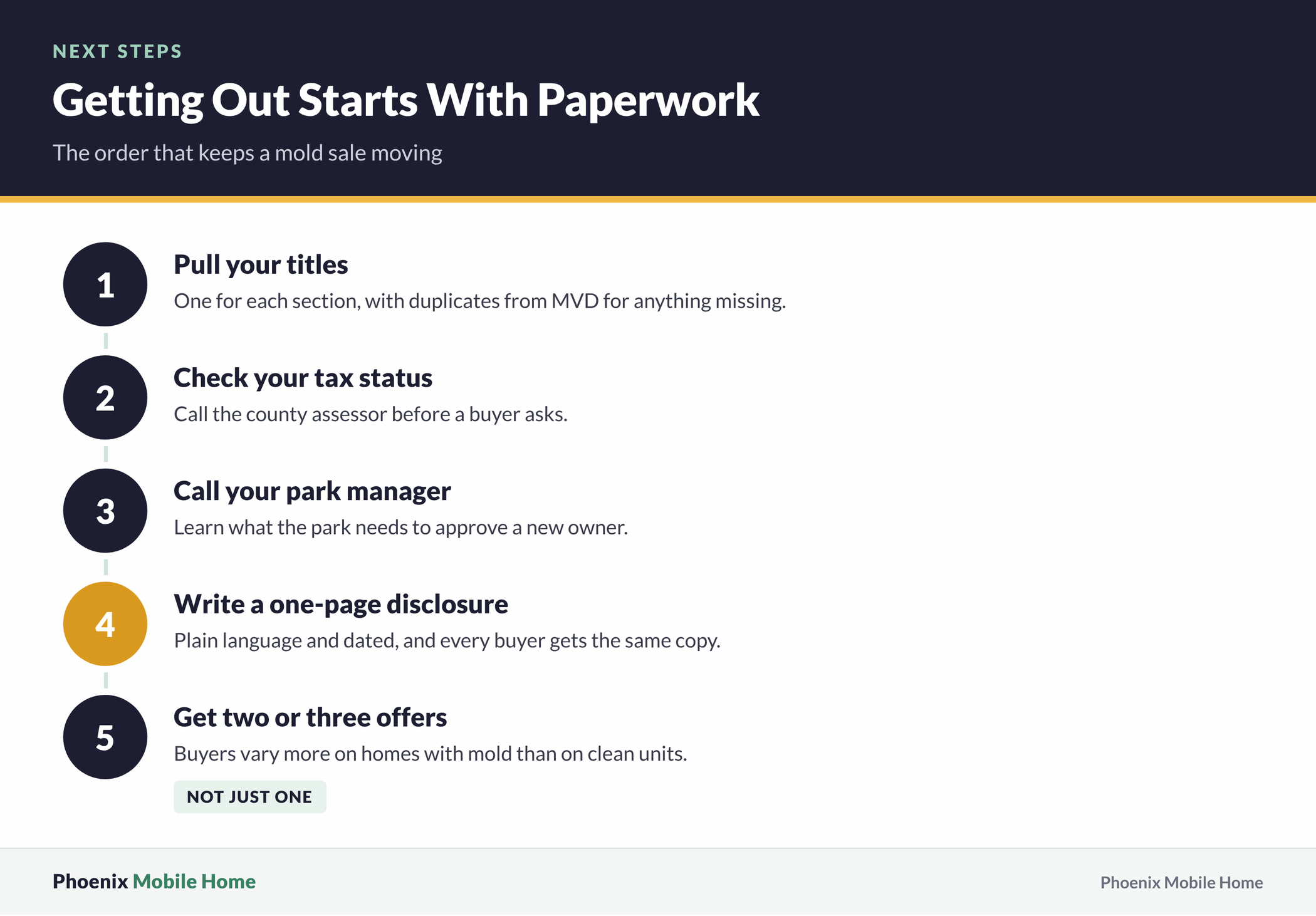
If what you need is maximum price and you’ve got six months, remediate properly and list retail. If what you need is out, start with paperwork. Pull your titles, pull your tax status with the county assessor, and call your park manager. Mold issues are the easy part of an Arizona mobile home sale compared to a title in a deceased parent’s name.
One page, plain language, dated. Every Arizona buyer you talk to gets the same copy, so nobody can claim a different story later.
Then get two or three offers. Not one. A seller who takes the first cash number in Arizona without comparison almost always leaves something behind. The spread between buyers on homes with mold issues is wider than on clean units because risk tolerance varies so much.
I worked with a woman in Sun City settling her father’s estate who had a kitchen gut estimate exceeding what the whole kitchen contributed to the home’s value, mold behind the sink cabinet included. She’d been sitting on it for eight months, paying lot rent, because a contractor told her she had to fix it first. She didn’t. The home sold as-is that spring, and the garage full of golf clubs went with it.
Frequently Asked Questions About Mold Issues in Arizona Mobile Homes
Do I Have to Tell Buyers About Mold Issues If I’m Selling As-is?
Yes. Arizona’s common-law disclosure duty applies to every residential sale, and the as-is label only removes your obligation to repair, not your obligation to tell. Put what you know in writing and give the same document to every buyer who looks at the home.
Will a Bank Finance a Mobile Home with Mold Issues in Arizona?
Almost never while the mold issues are active. Chattel lenders and FHA programs both require the home to meet condition standards, and visible mold or moisture damage fails that review. Plan on a cash buyer unless you remediate first and can show documentation of the work.
How Fast Can I Sell an Arizona Mobile Home with Mold Issues?
With a cash buyer who knows manufactured housing, two to three weeks is realistic once your titles are in order. Title complications are usually what stretch it out, especially missing paperwork or an estate that needs an affidavit. Park approval for the new owner can add a week or so.
If you’re staring at mold issues in an Arizona mobile home and you’re not sure which direction makes sense, I’m happy to walk through it with you. Bring your questions about titles, park rules, or what the home might be worth as-is. No pressure, no obligation, and no hard feelings if you decide to fix it up and list it instead.
Talk to Us About a Mobile Home With Mold
Stuck between fixing the mold and selling the home as it sits? Contact Phoenix Mobile Home and we’ll look at your situation with you. You can also fill out the short form below to get a cash offer on your mobile home. There’s no obligation and no pressure.