


A homeowner outside Maricopa once told me her yard smelled like a feedlot every July. She wasn’t kidding. Monsoon storms soak the ground around a failing drain field, and the odor finds you long before an inspector does. If you own a manufactured home on acreage and you’re staring down septic problems, you’ve got plenty of company among rural Arizona owners. Selling is still possible. It just doesn’t work like selling a tract home in Gilbert hooked to city sewer.
What Counts as a Failed Septic System in Arizona?
Replacing a tank and leach field on rural acreage can run well into five figures. This year’s installer price guides don’t even agree on the range. Where your job lands in that range decides whether you’re looking at a repair or a reckoning.
A system has failed when effluent surfaces in the yard, when sewage backs into the home, or when the soil treatment area no longer absorbs what you send it. Roots invade lines, tanks crack, and baffles rot out.
Desert soil makes this worse here than in wetter states. Caliche hardpan, which water barely moves through, sits under huge stretches of Pinal and Maricopa County. A drain field installed in the 1980s on a parcel near Apache Junction may have been marginal from day one.
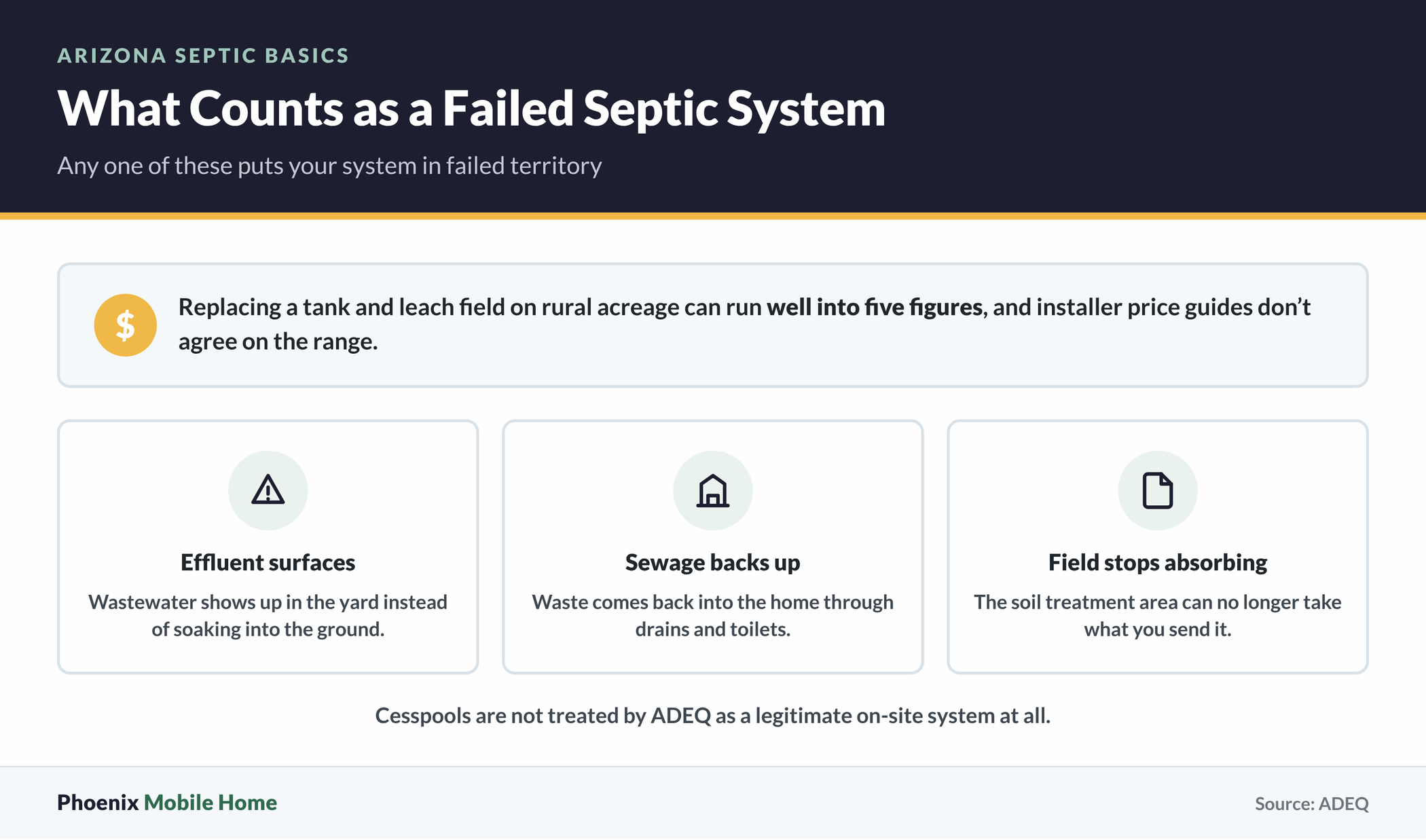
Age matters too. Some older rural homes still sit on cesspools, not real systems, and Arizona rules bar using a cesspool for sewage disposal at all. ADEQ doesn’t recognize cesspools as legitimate on-site systems. University of Arizona guidance tells a transfer inspector who finds one that the job turns into a disclosure to the buyer. Cesspools are a tougher spot than ordinary septic problems, since there’s nothing to repair.
A while back I bought a place in Casa Grande from two siblings who’d inherited it. Thirty years of belongings filled every room, the carport held a disassembled boat, and they just wanted out fast rather than clean. The septic problems there turned out to be a collapsed distribution box, a cheap fix hiding behind a scary smell.
Still, you can’t price your home honestly until someone qualified tells you which kind you have.
How Do You Know Your Mobile Home Has Septic Problems?
Waiting for a backup before you look into it is the most expensive decision an Arizona owner can make. By then you’ve usually lost the drain field.
One sluggish tub is a clog; every fixture crawling at once points at the tank. Gurgling toilets follow. Then comes the smell, strongest near the tank lid on still mornings.
Your yard tells you a lot. Grass that’s suddenly lush and green over the leach field in a Tucson June, when everything else is burned brown, means effluent is feeding it from below. Soggy ground anywhere in the desert deserves suspicion.
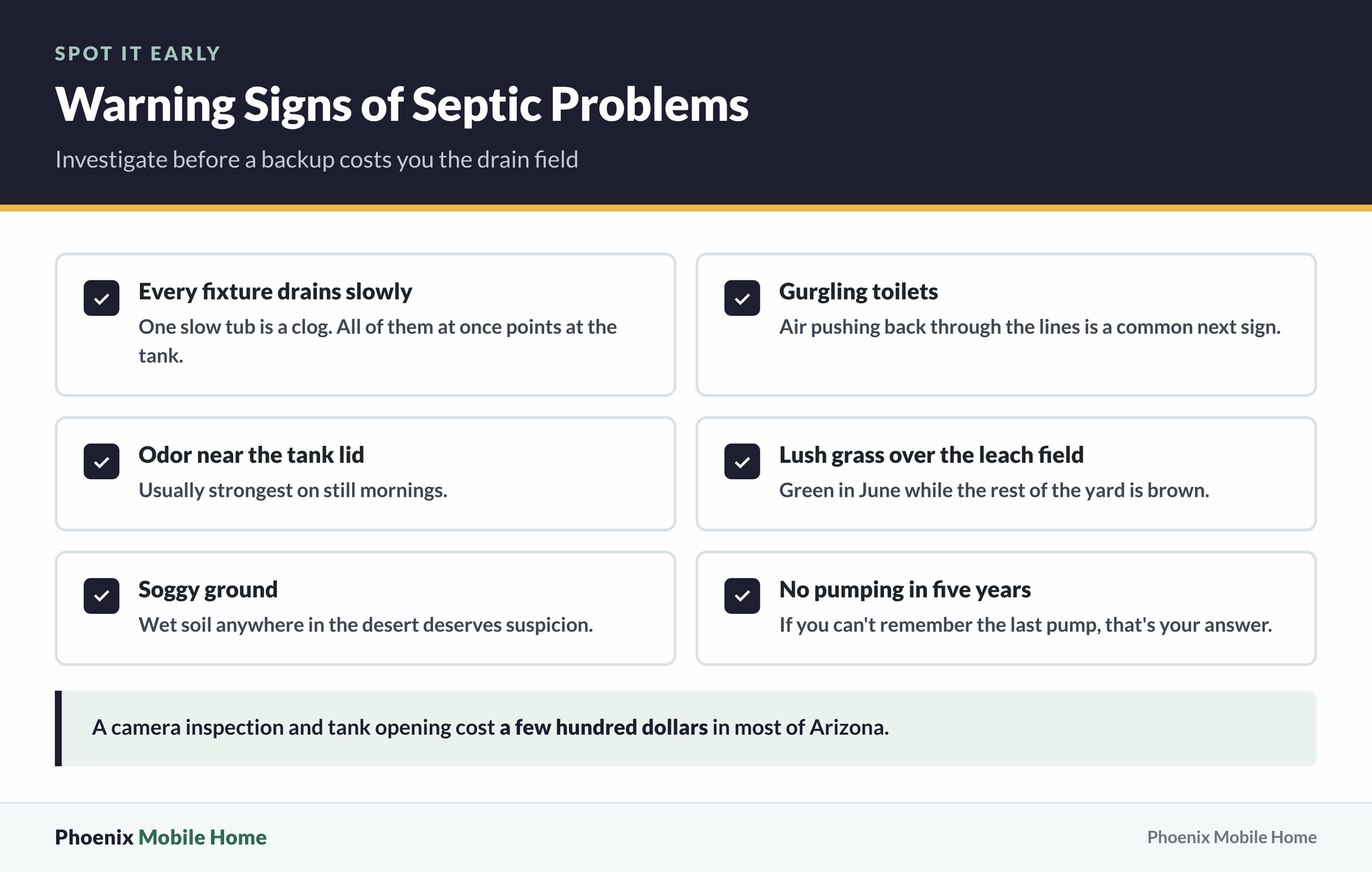
Have you had the tank pumped in the last five years? If you can’t remember, that’s your answer. Pumping intervals depend on household size and tank capacity. Skipped maintenance sits behind a large share of the septic problems I see on rural Arizona parcels.
Older homes in Rio Verde or out past Wittmann sometimes have records nobody kept. The county environmental health office usually holds permit files going back decades. Pulling yours shows the tank size, the install date and whether the system was ever permitted at all. An unpermitted system is its own kind of trouble.
Checking early costs you a pumping visit. Owners who wait pay for excavation instead. The gap between those two bills would buy a decent used truck.
A camera inspection and a tank opening cost a few hundred dollars in most of Arizona. That’s a cheap way to find out. Knowing exactly which septic problems you have lets you negotiate from knowledge instead of fear.
Do Arizona Sellers Have to Disclose Septic Problems?
“I’m selling as-is, so none of this applies to me.” I hear that one constantly, and it’s wrong. An as-is clause sets what condition the buyer accepts; it doesn’t let you hide a defect you already know about. Arizona courts have refused to let as-is language defeat a claim that a seller concealed or lied about a known problem.
There’s no disclosure form written by the legislature here. What exists instead is a duty, built from case law, to disclose known material facts that affect value and that a buyer couldn’t easily find alone. Septic problems clear that bar easily.
Most sales use the Arizona REALTORS® Seller’s Property Disclosure Statement, the SPDS. It asks whether the property runs on a conventional septic system or an alternative one. Next it wants the approximate date of the last inspection or pumping, and whether you know of past or present problems.
Under Arizona Administrative Code R18-9-A316, ADEQ requires the seller to hire a qualified inspector to perform a transfer of ownership inspection within six months before the property transfers. The inspector completes a Report of Inspection and hands it to you. Before closing, you pass it to the buyer along with any permit and maintenance records you hold. The buyer then files a Notice of Transfer within 15 calendar days after the transfer date.
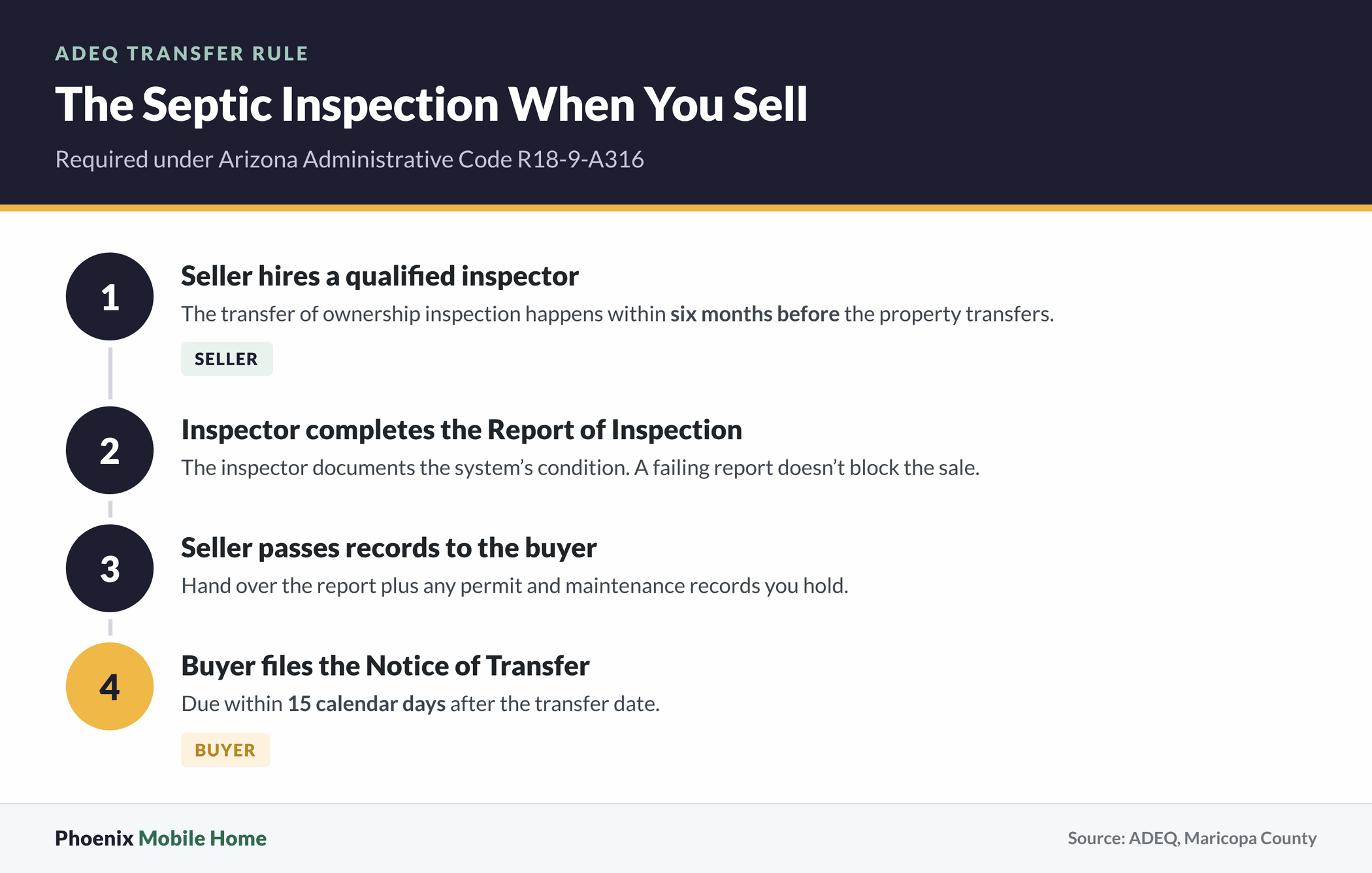
Maricopa County’s page on ownership transfer notes that this Arizona rule overrides conflicting contract terms.
Disclosing septic problems up front costs you less than a lawsuit two years later.
How Much Do Septic Problems Lower Your Mobile Home’s Value?
Listing at full retail with a note promising the tank is “fine” is the most common pricing mistake I see on rural parcels.
Value loss tracks repair cost, but not one to one. Buyers discount for the dollars plus the guesswork, and guesswork costs money. I’ve watched a drain field quote pull more off an offer than the quote itself, because nobody trusts a number on a system they haven’t opened.
Context helps here. Redfin’s Arizona data put the statewide median sale price at $428,217 in August 2026, down 0.88% from a year earlier. Homes took a median 66 days to sell. Manufactured homes sell in a different price tier. On those homes, a five-figure septic repair eats a far bigger share of your proceeds than it would on a Scottsdale resale.
The dirt carries a lot of the value on these properties. I’ve seen a manufactured home on five acres near Prescott Valley hold its worth mostly through the land. So septic problems hurt less, as a share of the price, than they do on a home in a park with no land at all.
Where the system sits also moves the number. Replacement costs climb when the tank or field runs under the driveway, an addition or mature mesquite, because of access. Buyers price that in once they see it.
Fresh roof, working HVAC, decent skirting: those offset septic problems in a buyer’s math, and I’ve watched clean mechanicals pull an offer up by thousands.
Will Septic Problems Scare Off Arizona Buyers?
Some of them, yes.
You’ll lose retail buyers who need financing. Lenders want a working septic system, and an FHA appraiser who suspects a problem can make an inspection a condition of the loan. FHA loans on manufactured homes add their own property rules on top of that. A failing system can knock financed Arizona buyers out of the running.
Cash buyers see it differently. They aren’t waiting on an appraiser or an underwriter, so septic problems become a line item instead of a reason to walk. Think of someone who wants horse acreage outside Buckeye, or a contractor who can trench his own field.
What really scares buyers off is vagueness. Saying “there might be an issue” with no inspection or quote invites everyone to picture the worst. Hand them a Report of Inspection and two contractor bids, and the talk turns to simple math.
Timing helps too. Late winter through spring is when this market runs busiest. Snowbirds and out-of-state buyers are both shopping then. A septic problem does better competing then than sitting alone in August.
Local buyers who’ve owned rural property here won’t flinch. They’ve replaced a leach field before, and they know the number.
Can You Sell a Mobile Home in Arizona with Septic Problems?
For years I assumed a failed system meant the seller had to fix it before anyone would close.
You can sell a manufactured home in Arizona with septic problems. What you can’t skip is the transfer of ownership inspection, because ADEQ’s rule attaches to the transfer itself, not to the system’s condition. A failing report doesn’t block the sale. It documents reality.
The practical questions are who buys it and at what discount. Cash buyers, investors and people buying on owner financing take these properties all the time, so a failing septic rarely scares them off. Some buyers escrow funds for repairs. Others simply take the system as it stands and budget for replacement in year one.
If the home is still titled through the Arizona Department of Transportation and hasn’t been affixed to the land, you’re transferring two assets, not one. Sort that out early with your title company.
Companies that specialize in this niche make the process simpler. Phoenix Mobile Home buys manufactured homes throughout Arizona in their current condition, including properties with septic problems that would stall a traditional listing.
Will an investor lowball you? Not if you’ve done the inspection and know the repair number. Informed sellers negotiate well; uninformed ones accept whatever gets offered.
Rural Arizona has a lot of these homes, from Mohave Valley to the Sulphur Springs Valley. There’s a working market for them, even with a failing system in the yard.
What Are Your Options for Selling a Mobile Home with Septic Problems?
Choose wrong here and you spend five figures on a new system, then sell for roughly what you’d have gotten selling as-is.
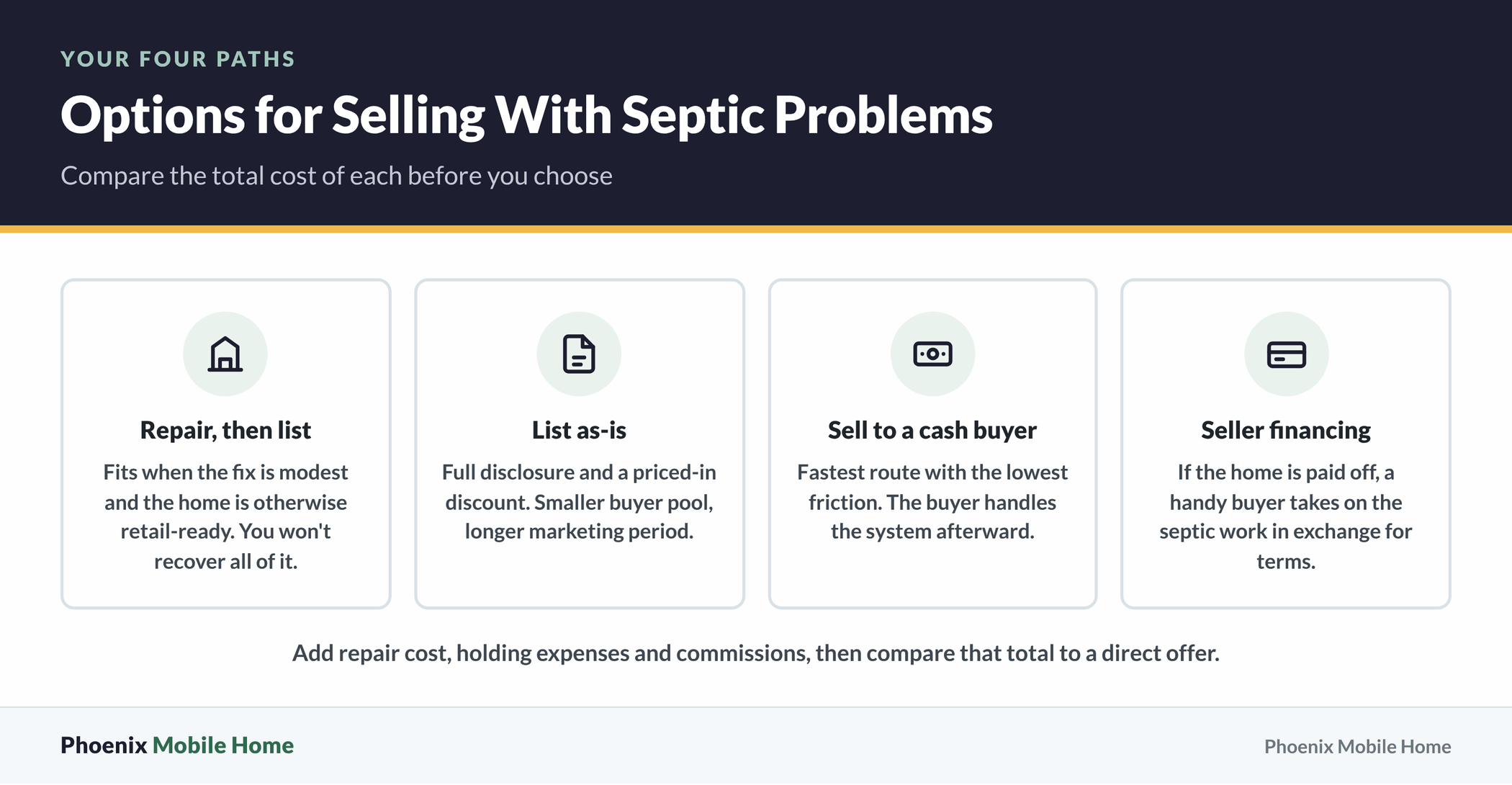
Option one: repair or replace, then list. This makes sense when the fix is modest, your home is otherwise retail-ready, and you have the cash and the patience. You won’t recover all of it.
The second option: list as-is with full disclosure and a priced-in discount. Expect a smaller buyer pool and a longer marketing period than a typical Arizona listing.
Option three: sell directly to a cash buyer who handles the system afterward. Fastest route, lowest friction, and the discount is usually smaller than sellers fear once you subtract commissions, holding costs and the repair you’d otherwise fund.
Often overlooked is option four: seller financing. If your home is paid off, carrying a note lets a handy buyer take on the septic problems in exchange for terms they can’t get from a bank. Plenty of buyers are in that position.
A man called on a Wednesday afternoon from Bullhead City. His drain field had surfaced that spring, his detached garage was full of welding equipment he needed to move, and he had no cash to replace the system. We bought it as-is with the septic repair priced in, and he kept the welding gear.
Add your likely repair cost, holding expenses and commissions, then compare that total against a direct offer. Speed wins when the spread is thin. A firm like Phoenix Mobile Home can look at your numbers and tell you whether a direct sale beats a listing for your property in Arizona.
Frequently Asked Questions About Septic Problems in Arizona
How Many Bedrooms Will a 1,500-gallon Septic Tank Support?
Under the state’s sizing table, a 1,500-gallon tank is the minimum for a four-bedroom home with more than 28 fixture units or a five-bedroom home with 35 or fewer. The table counts plumbing fixtures along with bedrooms, and soil conditions decide how big the soil treatment area has to be. A home with more bedrooms than the permit on file shows needs that sorted with the county before listing, since buyers and lenders both check.
Can I Sell a Mobile Home in Arizona If the System Was Never Permitted?
Yes, but plan on a cash buyer. An unpermitted system is one of the harder septic problems to clear because there’s no county record showing what’s buried out there. Your options are working with the county to get it documented, full replacement, or selling to a buyer who prices the unknown and handles it after closing.
Who Pays for the Septic Inspection in an Arizona Sale?
The seller hires the qualified inspector under the state rule, and the buyer handles the Notice of Transfer filing afterward. In practice, who absorbs the inspection cost is something you can work out, and I’ve seen buyers cover it on properties they badly wanted. The filing deadline after transfer is short, so make sure your buyer knows it’s their job.
Will Septic Problems Stop a Buyer From Getting a Loan in Arizona?
Usually, yes, if the system is failing right now. Lenders and appraisers on manufactured housing want a working wastewater system, and surfacing effluent tends to trigger required repairs before funding. That’s why so many Arizona homes with septic problems trade to cash buyers and investors instead of financed retail buyers.
Talk to Us About a Mobile Home With Septic Problems
If you’ve got a manufactured home sitting on a system that’s failing and you’re not sure which direction to go, I’m glad to talk it through with you. Bring whatever you have: an old permit, a contractor’s quote, or nothing but a smell in the backyard. We can look at the numbers together and you can decide from there. No pressure, no obligation, and no hard feelings if you choose to fix it and list it the traditional way.
Not sure whether to fix the system or sell the home as it sits? Contact Phoenix Mobile Home and we’ll look at your situation with you. You can also fill out the short form below to get a cash offer on your mobile home.